Deployment Case Studies
Real-world deployments demonstrating measurable outcomes across enterprise, carrier, and government environments.
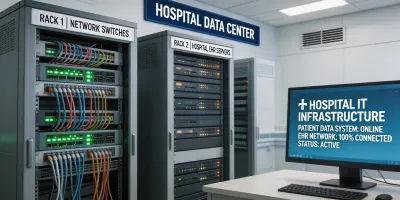
Multi-Campus Healthcare Network
Background: A 12-facility regional healthcare system in the Southeast US needed to replace aging Cisco Catalyst 3750 stacks that could not support 802.3bt PoE for new clinical IoT devices (patient monitors, infusion pumps, nurse call terminals).
Deployment: Our team installed 480 Tripp Lite TL-4800P PoE++ switches across all facilities over a 14-week phased rollout. Each switch was pre-configured and staged in our Austin facility with VLAN templates, 802.1X policies, and LLDP-MED profiles for each device class.
Result: Network uptime reached 99.997% over the first 12 months. The pre-staging approach reduced on-site deployment time by 65% compared to the previous refresh cycle. Total PoE budget utilization averaged 68%, providing headroom for planned telemedicine expansion in 2027.

Large University Wi-Fi 6E Campus
Background: A state university with 45 buildings and 28,000 concurrent users experienced wireless congestion during peak class hours, with legacy Wi-Fi 5 APs unable to serve high-density lecture halls reliably.
Deployment: 1,200 Tripp Lite TL-AP6E access points deployed with centralized Tripp Lite wireless controllers. Automated RF optimization and zero-touch AP provisioning reduced per-building installation from 3 days to 8 hours.
Result: Peak-hour wireless throughput improved by 3.2x. IT support tickets related to wireless connectivity dropped 54% in the first semester. TCO was reduced by 40% over a 5-year projection, primarily through controller consolidation and reduced on-site labor.

Federal Agency Zero Trust Network
Background: A US federal agency required a campus backbone upgrade to meet Executive Order 14028 (Improving the Nation's Cybersecurity) Zero Trust mandates. Existing infrastructure lacked port-level encryption and microsegmentation capability.
Deployment: 320 Tripp Lite TL-5200M managed switches installed across 8 buildings with MACsec 256-bit encryption on every inter-switch link. 200+ VLANs configured with hardware-enforced ACLs for microsegmentation. RADIUS integration with PIV/CAC card authentication.
Result: Achieved 100% encrypted east-west traffic across the campus backbone. Forwarding latency remained under 800 nanoseconds even with full MACsec enabled. The agency passed its first NIST 800-53 Zero Trust compliance audit within 90 days of deployment completion.