
Network infrastructure engineered for mission-critical environments — from hyperscale data centers to secure government facilities and healthcare campuses.
Spine-leaf architectures built on Tripp Lite 100G switches with sub-microsecond east-west latency. Our 25G/100G ToR switches support VXLAN fabric overlay, EVPN multi-tenancy, and hitless ISSU upgrades — critical for hyperscale and colocation environments operating at 99.999% SLA targets.
Request Data Center Solutions Brief
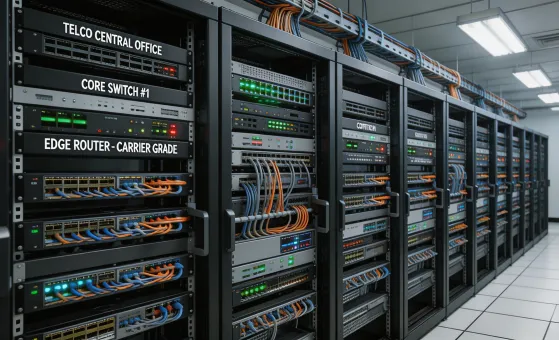
NEBS Level 3 validated edge and aggregation routers deployed across carrier access networks. Support for MEF CE 2.0 Carrier Ethernet services, G.8032 ring protection, and multi-service delivery platforms capable of handling 5G backhaul and enterprise leased line services simultaneously.
Discuss Carrier RequirementsMACsec-encrypted campus backbones meeting NIST 800-53 Zero Trust requirements. FIPS 140-2 validated encryption modules available for classified network segments.
PoE++ switches powering clinical IoT ecosystems — nurse call systems, patient monitors, infusion pumps, and real-time location tracking. 802.1X authentication with dynamic VLAN isolation for HIPAA compliance.
Wi-Fi 6E campus deployments supporting 28,000+ concurrent users. Centralized management with automated AP provisioning, guest network isolation, and BYOD onboarding workflows.
Low-latency switching for trading floor infrastructure. Hardware timestamping with nanosecond precision, PTP boundary clock support, and encrypted east-west traffic for regulatory compliance.
Ruggedized switches with extended temperature range (-40°C to +75°C) for factory floor and outdoor cabinet deployments. TSN-ready for deterministic industrial Ethernet.
PoE-powered point-of-sale, digital signage, and guest Wi-Fi infrastructure. Cloud-managed switches with zero-touch provisioning for distributed multi-site deployments.
Selecting the right platform depends on your specific environment. Below are key constraints to evaluate during planning.
Standard Tripp Lite switches (TL-4800 series) are rated for indoor use at 0°C to +50°C. Outdoor cabinet, rooftop, or industrial environments require the ruggedized TL-R series (-40°C to +75°C, IP67), which are available in a subset of port configurations (8/16/24 ports only, no 48-port ruggedized model currently available).
Tripp Lite switches are fully standards-compliant (IEEE 802.3, LACP, STP/RSTP/MSTP, BGP, OSPF) and interoperate with third-party equipment at layer 2/3. However, advanced features such as centralized management, automated AP provisioning, and DPA (Dynamic Power Allocation) require an all-Tripp Lite deployment. Mixed-vendor environments should plan for manual configuration of these features.
Choosing the right switching and routing platform depends on measurable criteria. The table below outlines key comparison dimensions that apply across industries.
| Selection Dimension | What to Measure | Tripp Lite Specification | Industry Range (Enterprise Tier) |
|---|---|---|---|
| Switching Latency | Cut-through latency per RFC 2544 | <800 ns (measured) | 800 ns – 5 μs |
| PoE Budget per Switch | Total watts available for powered devices | Up to 2,400W (802.3bt Type 4) | 740W – 2,400W |
| Port-Level Encryption | MACsec hardware engine per port vs. shared | Dedicated per-port MACsec 256-bit AES-GCM | Varies: shared or per-port |
| Environmental Certification | NEBS Level 3, MIL-STD-810H, IP rating | NEBS L3 + MIL-STD-810H validated in-house | Typically NEBS L1 or L3 |
| Lifecycle Support | Years of firmware patches + hardware RMA | 10-year commitment (quarterly patches) | 3–7 years typical |
| Maximum Uplink Speed | Highest available port speed | 100G (400G in qualification, expected H1 2027) | 100G – 400G |
Industry range data based on published datasheets from major enterprise networking vendors as of Q1 2026. Actual specifications vary by model and configuration.
Our application engineers specialize in vertical-specific deployments and can recommend the optimal product configuration for your environment.
Discuss Your Requirements